
Diamond flap discs represent a major innovation in the field of abrasive tools, designed for the efficient and precise machining of hard materials. Unlike traditional abrasive wheels made of abrasives such as silicon carbide or zirconium oxide, diamond flap discs utilize the unparalleled hardness of diamond to achieve superior performance.
Definition
Diamond flap discs are electroplated abrasive tools whose unique layered structure gives them superior performance. The base material of the grinding wheel is typically made of durable materials such as nylon or fiber cloth, combining flexibility and strength. Thin diamond flakes are deposited on the base material through an electroplating process, forming a strong and uniform surface and embedding hard diamond abrasive particles. This electroplating process ensures that the diamond particles adhere firmly, forming a sharp cutting edge, thereby improving the grinding performance of the grinding wheel.
Diamond abrasive wheels are available in a variety of sizes, including 4-inch, 4.5-inch, and 5-inch, and can be mounted on tools with M14 or 5/8”-11 bushings, making them compatible with a wide range of grinders.
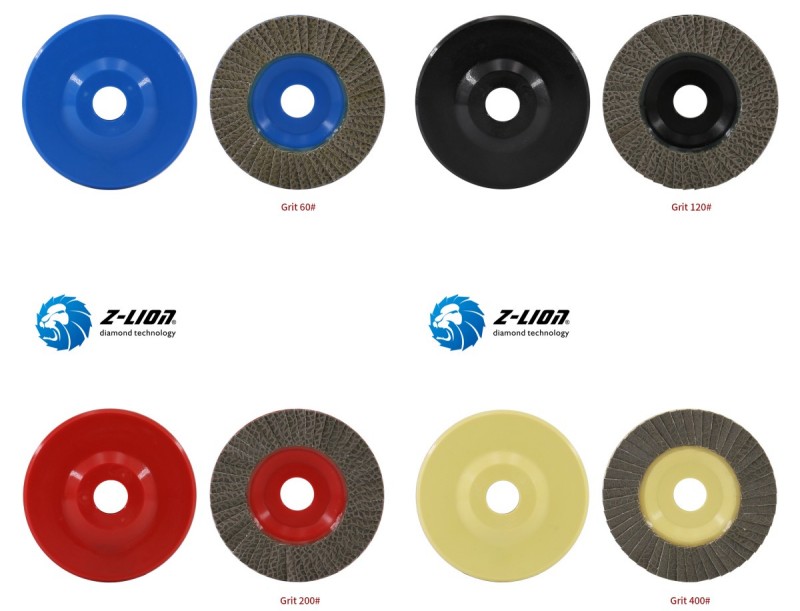
Properties of Diamond Flap Discs
High efficiency and wear resistance:
One of the key features of diamond flap discs is their high efficiency in grinding hard materials. The unparalleled hardness of diamond allows these abrasive wheels to grind hard alloys, ceramics, glass, and other materials more effectively than traditional grinding wheels. This efficiency translates into faster processing speeds and lower labor costs.
In addition, diamond flap discs have an extremely long service life. Unlike traditional grinding wheels that wear out easily, the diamond-coated surface can maintain its cutting ability for a long time, making it an economical choice for heavy-duty operations.
Excellent heat dissipation and strong flexibility:
The unique layered structure of diamond flap discs ensures excellent heat dissipation during grinding. This characteristic reduces the risk of overheating and workpiece burnout, which is especially important when machining sensitive materials.
The base material of abrasive discs is typically made of nylon or fiber cloth, which has a certain degree of flexibility. This flexibility allows the abrasive disc to adapt to complex surfaces, ensuring uniform grinding without damaging the edges and corners of the workpiece. Therefore, even on irregularly shaped surfaces, users can obtain a high-quality surface finish.
Sharp cuts and high smoothness:
The electroplating process used in the manufacturing of diamond flap discs results in a high concentration of diamond particles on the wheel surface. This creates a sharp cutting edge and a large chip removal space, thereby improving the cutting efficiency of the abrasive wheel.
The sharpness of diamond particles minimizes clogging during use, thereby improving the smoothness of the machined surface. This is particularly advantageous in applications requiring extremely high surface finish, such as the automotive, aerospace, and arts industries.
Applications of Diamond Flap Disc
Hard alloy:
Diamond flap discs are particularly suitable for grinding and polishing cemented carbide. They are commonly used in the manufacture of cutting tools and molds, where precision and durability are paramount. The powerful cutting action of diamond particles efficiently removes material, resulting in a fine surface finish that meets stringent quality standards.
Stone and ceramics:
In the stone industry, diamond flap discs excel at grinding, chamfering, and machining the slightly curved surfaces of materials such as granite and ceramic tiles. They can adapt to complex shapes, ensuring even grinding without damaging the edges or corners of the workpiece. Therefore, they are suitable for both roughing and fine finishing.
Glass:
Diamond flap discs are widely used for edge grinding and surface modification of glass products. The sharp cutting edges of the diamond particles enable clean cuts and smooth surface finishes, which are crucial for applications such as glass processing and installation. They effectively reduce glass chipping and cracking, making them the preferred choice for glass processing professionals.
Composite materials:
Diamond flap discs have a wide range of applications, including machining composite materials, including carbon fibers and reinforced plastics. These materials often present unique machining challenges due to their hardness and brittleness. Diamond flap discs provide the necessary cutting forces to achieve precise machining while minimizing damage to the workpiece.
Summary
Electroplated diamond flap discs have become indispensable tools in modern precision manufacturing and hard material processing due to their superior characteristics such as high efficiency, durability, and flexibility. They can grind and polish a variety of materials, and are therefore increasingly popular in various industries, often replacing traditional abrasive wheels.
However, the cutting force of diamond flap disc also poses certain risks. Operators should wear appropriate protective equipment, such as goggles, gloves, and masks, to ensure their safety. Strict adherence to safety procedures is crucial for preventing accidents and ensuring a safe working environment.
The market for diamond-coated abrasive wheels is expected to expand as demand for high-performance grinding tools continues to grow. Innovations in size, shape, and design are anticipated to further enhance their application range and efficiency. In short, diamond flap discs are essential grinding tools, offering unparalleled performance in machining hard materials, making them a key tool in a wide range of industrial applications.
Post time: Dec-05-2025