
Polishing is a crucial process in ceramic production, significantly impacting all aspects of the final product. From improving surface finish to enhancing dimensional accuracy, polishing plays a vital role in ensuring ceramic materials meet the stringent requirements of modern applications.
Polishing Can Affect the Following Aspects of Ceramics
1. Surface treatment
One of the main advantages of ceramic polishing is improved surface finish. Polishing effectively removes roughness and inhomogeneity from the surface of ceramic materials, resulting in a higher quality surface finish. This is particularly important for applications such as optical components, laser parts, and semiconductor materials, as surface finish directly affects optical performance and accuracy.
Optical ceramics: Polishing is of paramount importance for optical ceramics. The effectiveness of these advanced materials in optical applications largely depends on their surface quality. Polishing improves optical quality by reducing light scattering and reflection, thereby increasing light transmittance and transmission performance. Furthermore, polished optical ceramics exhibit long-term optical stability, making them suitable for harsh environments. The enhanced abrasion and corrosion resistance resulting from polishing further improves their durability under harsh conditions, ensuring optimal performance in fields such as optics, laser technology, optical communication, and optical sensing.
2. Dimensional and shape accuracy
Polishing also plays a crucial role in improving the dimensional and shape accuracy of ceramic products. By precisely controlling processing parameters and techniques during the polishing stage, manufacturers can fine-tune ceramic products to meet precise design specifications. This precision is essential for applications requiring tight tolerances, ensuring that the final product perfectly matches its intended use.
3. Surface smoothness
Polishing removes bumps and depressions from the surface of ceramic products, significantly improving surface smoothness. Improving surface smoothness offers several benefits:
Reduced contact pressure: A smoother surface reduces the contact pressure and friction between the abrasive and the product surface, thereby reducing wear and minimizing the cutting action of the abrasive on the ceramic.
Performance enhancement: Polished ceramic products have a smoother surface and typically offer superior wear resistance, which is crucial for high-precision applications such as mechanical parts and sealing elements. This ensures long-term reliable operation.
4. Surface quality and wear resistance
Polishing makes the surface of ceramic products smoother and more delicate, thus improving surface quality. A smooth surface has several advantages:
Minimize frictional resistance: Polished surfaces reduce frictional resistance and adhesion, thereby minimizing wear and abrasive damage during use.
Eliminating microscopic defects: Polishing removes sharp edges and roughness at the microscopic level, reducing the likelihood of particle embedding and scratches. This improvement is particularly important for applications requiring high wear resistance and fatigue resistance, such as ceramic bearings and cutting tools.
What Processing Techniques Should Be Considered During Polishing?
1. Selection of polishing media and abrasives
The selection of polishing media and abrasives is crucial for achieving the desired surface finish on ceramic materials. Different ceramic materials possess unique properties, requiring specific polishing techniques. Here are some important considerations:
Material compatibility: Different ceramic materials, such as alumina, zirconium oxide, or silicon nitride, have different hardness and structural properties. Selecting the appropriate polishing media and abrasives based on these properties is crucial for effective polishing.
Hardness: The hardness of the abrasive should be greater than the hardness of the ceramic material being polished. For example, diamond abrasives are often used to polish very hard ceramics due to their excellent hardness and cutting ability.
Particle size and shape: The size and shape of abrasive particles significantly affect polishing results. Finer particles produce a smoother surface, while coarser particles are better suited for initial grinding and removing larger imperfections. The shape of the abrasive also affects its interaction with the ceramic surface, thus influencing the efficiency and quality of the polishing process.
Commonly used polishing media:
There are various polishing media commonly used in ceramic production, each with its specific purpose:
Polishing paste: This thick, paste-like substance consists of abrasive particles suspended in a lubricant. It is widely used for hand polishing and specific applications requiring high-precision polishing. Polishing paste is particularly suitable for ceramic products, enabling them to achieve a high-gloss surface.
Polishing slurry: This liquid medium contains suspended abrasive particles and is typically used in wet polishing processes. Polishing slurries must be used in conjunction with suitable polishing equipment (such as rotary or vibratory polishing discs). They provide a uniform abrasive distribution, resulting in more precise and consistent polishing results.
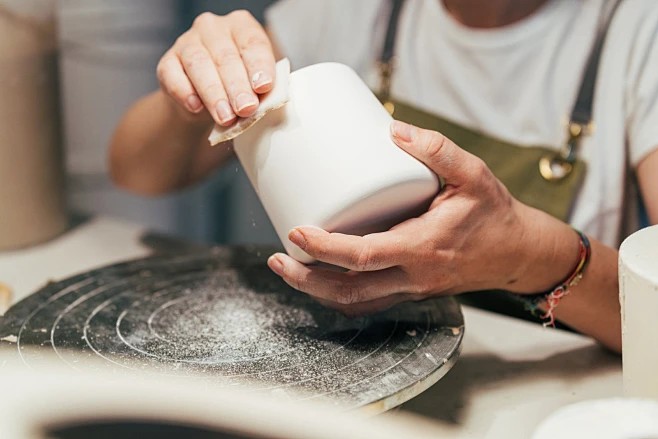
Polishing paper: Polishing paper is a type of paper or film coated with abrasive particles. It is commonly used for hand polishing and treating small areas of ceramic products. Polishing paper comes in various grit sizes, allowing you to choose the appropriate grit for different polishing levels.
Commonly used abrasives:
The choice of abrasive is crucial to the success of the polishing process. Commonly used abrasives in ceramic polishing include:
Silicon carbide abrasives: Silicon carbide abrasives are known for their hardness and sharpness, and are effective at grinding and polishing a variety of ceramic materials. They are commonly used in both dry and wet polishing operations.
Alumina abrasives: These abrasives have a wide range of applications and can be used for various polishing tasks. Alumina is particularly suitable for the fine polishing of ceramics and is usually used in conjunction with polishing pastes.
Diamond abrasives: Diamond abrasives are the hardest known material and are ideal for polishing high-hardness ceramics. They possess excellent cutting capabilities and are commonly used in high-precision applications requiring extremely high surface finishes.
2. Polishing pressure and speed
During the polishing process, the pressure applied to the surface of the ceramic product and the moving speed of the polishing head are key parameters:
Polishing pressure: Appropriate pressure is crucial for achieving the desired surface smoothness and flatness. Excessive pressure can lead to excessive wear or thermal damage, while insufficient pressure may fail to effectively polish the surface.
Travel speed: The travel speed of the polishing head also affects the polishing effect. Optimizing pressure and speed, based on the specific ceramic material and the desired surface finish, is crucial for achieving high-quality polishing results.
3. Polishing time and cycle
The contact time and number of cycles between ceramic products and polishing media and abrasives are crucial for achieving the desired surface quality.
Polishing time: Sufficient time must be allowed to ensure effective contact between the polishing medium and the ceramic surface. Too short a time may result in insufficient polishing, while too long a time may lead to wear or surface damage.
Polishing cycle count: The number of cycles should be adjusted based on the material and the desired surface finish. Each cycle should progressively refine the surface to ensure the final product meets the required specifications.
4. pH value and temperature of the polishing solution
The properties of the polishing slurry have a significant impact on the polishing process:
pH value: The acidity or alkalinity of the polishing solution affects the chemical reactions and exfoliation during the polishing process. Maintaining a suitable pH value is crucial for achieving optimal polishing efficiency and surface quality.
Temperature: The temperature of the polishing slurry also affects the polishing effect. Higher temperatures can increase the reaction rate, while lower temperatures will slow it down. Adjusting and controlling these parameters according to the specific polishing materials and process requirements is crucial.
5. Selection and design of polishing tools
The selection and design of polishing tools play a crucial role in the effectiveness of the polishing process.
Tool compatibility: Selecting appropriate polishing tools, such as polishing heads and polishing discs, is crucial. These tools should be compatible with the ceramic material being polished and provide the necessary rigidity and surface properties.
Design parameters: The shape, hardness, and dimensions of the polishing tool should be optimized to ensure good polishing results and consistency. A well-designed tool can improve polishing efficiency and the overall quality of the finished product.
Is Polishing the Final Step in the Manufacturing Process of Ceramic Products?
Final polishing step
In many cases, polishing is the final step in the manufacturing process of ceramic products. This is especially important when the goal is to achieve a high-quality surface finish. Polishing effectively removes imperfections, burrs, and particles that may have formed in the earlier stages of production, resulting in a smoother, more uniform surface. This is crucial for applications that combine aesthetics and functionality, such as:
Optical ceramics: Products used in optical applications require a perfect surface to ensure optimal light transmittance and minimal scattering.
Precision components: Ceramics used in mechanical applications typically require highly smooth surfaces to reduce friction and wear.
In these cases, polishing is usually the last step performed before the final product is finalized to ensure that the product meets quality and performance requirements.
Polishing before subsequent processing
However, polishing is not always the final step. Some ceramic products may require additional surface treatments, such as:
Coating: Applying a protective or decorative layer to enhance durability or aesthetics.
Electroplating: Adding a metal layer to improve conductivity or corrosion resistance.
Spray coating: Surface treatment performed for specific functional or aesthetic purposes.
In such cases, polishing is necessary before these treatments to prepare the surface and ensure it is suitable for subsequent processing. A polished surface allows for better adhesion of coatings and other treatment agents, ultimately improving product performance and lifespan.
Multi-step polishing process
For some high-precision ceramic products, the manufacturing process may involve multiple steps, including multiple polishing processes. In this case, polishing may be interspersed between other processing steps to gradually achieve the required precision. This iterative approach allows manufacturers to progressively improve the surface, ensuring that each stage of production contributes to the final quality of the product.
Other post-processing steps
Depending on the specific product and its intended use, further post-processing steps may be required after polishing. These steps may include:
Cleaning: Removes residual polish or contaminants to ensure a clean surface.
Inspection: Conduct quality control checks to verify that the product meets all specifications and standards.
Final coating or treatment: Applying the necessary final treatment to the product to achieve its intended use.
The order and combination of these steps can vary greatly depending on product requirements and the characteristics of the manufacturing process.
Post time: Feb-27-2026