
In the field of stone and concrete surface finishing, creating textures that are both aesthetically pleasing and functional remains a key challenge. You might ask , what is a bush hammer? It is a specialized finishing tool capable of transforming smooth, monotonous surfaces into finishes with distinct textures and pronounced character, while also enhancing slip resistance. Whether you’re creating a slip-resistant surface for outdoor steps or achieving the classic bush hammered look on building facades, understanding and selecting the right bush hammer is essential.
This guide will serve as your technical advisor, systematically covering everything from basic concepts to advanced selection criteria to help you complete your projects more efficiently.
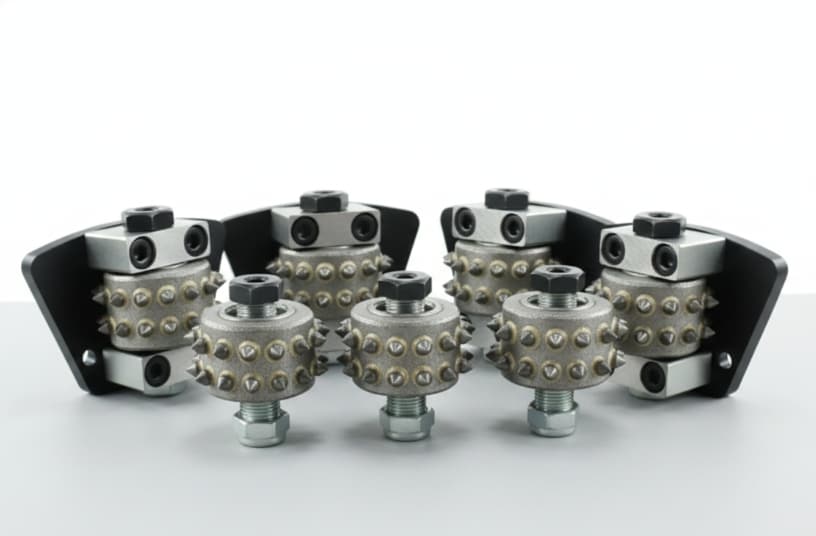
What Is a Bush Hammer?
Simply put, a bush hammer is an impact tool equipped with multiple hardened points made of Tungsten Carbide. Its core function is not grinding or cutting, but rather creating a uniform, rough texture on hard surfaces through high-frequency striking.
This treatment makes it indispensable for the following three primary applications:
Anti-slip treatment: Creating a rough surface on concrete or stone steps, ramps, and outdoor plazas to significantly improve safety in wet conditions.
Decorative Finishing: Creating the classic “Litchi Finish” or “Pineapple Finish” effect, adding texture and visual appeal to building facades, floors, and landscape stone.
Surface Preparation: Creating a rough profile on old concrete to enhance the mechanical adhesion of new coatings, coverings, or repair mortars.
What Materials Can Be Bush Hammered?
The bush hammer is primarily used on high-hardness materials. The most common applications include:
● Concrete: Used to expose aggregate or create non-slip industrial flooring.
● Granite: A very popular choice for outdoor paving and architectural finishes.
● Marble: Primarily used to create unique decorative effects.
● Other Natural Stones: Such as limestone and sandstone, used in landscaping and construction projects.
How Does a Bush Hammer Work?
Understanding how it works is essential. Unlike grinding discs, which shape surfaces by “grinding away” material, a texturing hammer relies on the high-frequency impact of its teeth to continuously “tap” the surface. Each tap causes microscopic fractures on the material’s surface, exposing a new, rough layer. It is this controlled, repetitive impact process that ultimately creates a uniform, consistent textured finish.
What are the Different Types of Bush Hammer?
With technological advancements, bush hammers have evolved from simple manual tools into efficient power tool attachments. Selecting the appropriate type based on project requirements is key to balancing efficiency and results.
Hand-held Bush Hammer
- Overview: The most traditional form, which is a heavy-duty hammer equipped with a bush hammer head.
- Applications: Small-area repairs, edge finishing, or artistic projects requiring precise manual control.
- Pros and Cons: The advantage is that it requires no power and offers flexible control. The disadvantages include high physical exertion, low efficiency, and difficulty in maintaining consistent texture over large areas.
Plate Bush Hammer
- Overview: A large metal plate mounted on a heavy-duty floor grinder, featuring multiple bush hammer rollers or heads on its surface.
- Applications: Large-scale commercial or industrial flooring projects, such as parking lots, warehouses, and plazas.
- Pros and Cons: Extremely efficient, capable of quickly treating large areas. Cons include high equipment costs and unsuitability for walls or irregular surfaces.
Bush Hammer Cup Wheel
- Overview: Resembles a diamond grinding wheel in appearance and is designed for use on handheld angle grinders.
- Applications: Suitable for treating walls, countertops, stair treads, and corners and edges that is hard to reach.
- Pros and Cons: More efficient and maneuverable than a hand hammer, but its efficiency remains limited for large-scale floor work.
Bush Hammer Roller
- Overview: A modern, more efficient, and versatile solution. It converts impact motion into a smooth rolling action and is typically mounted on an angle grinder or floor grinder.
- Applications: Suitable for nearly all applications, from small countertops to large concrete floors.
- Pros and Cons: Offers outstanding efficiency and highly consistent textural results. The rolling design significantly reduces operator fatigue. As experts in flexible diamond tools, Z-LION’s bush hammer rollers are precision-engineered to ensure exceptional durability and performance, perfectly embodying our brand philosophy of “Think for your time.”
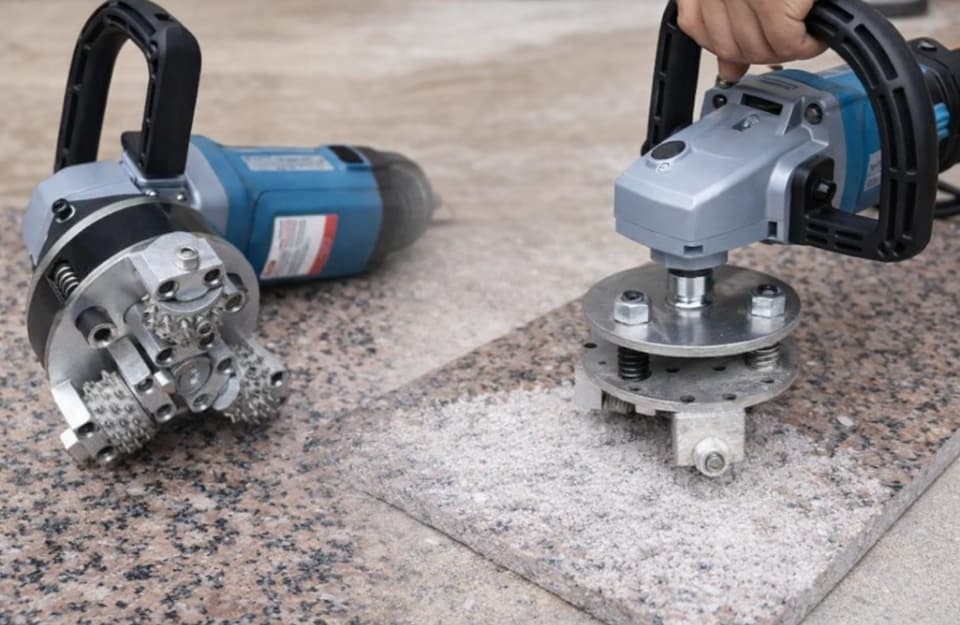
What Power Tools Use a Bush Hammer?
Matching the right bush hammer attachment to your equipment is key to achieving ideal results.
Angle Grinders: The most versatile option, typically paired with bush hammer cup wheels and bush hammer rollers. Ideal for vertical surfaces, countertops, and small to medium-sized floor projects.
Floor Grinders: Professional heavy-duty equipment suitable for large-scale operations, primarily paired with plate bush hammers and large roller attachments.
Rotary / Demolition Hammers: These tools use specialized bit-style bush hammer attachments. They work via powerful, direct impacts and are suited for deep texturing on small areas or removal tasks.
How to Choose the Right Bush Hammer Tool?
Making the right choice can significantly improve your work efficiency and the final quality of your work. Follow these four steps to make an informed decision for you and your team.
Step 1: Analyze Your Project Scale
Is your project a small-scale repair or a large-scale project? For repairs as small as a few square meters, a handheld tool may suffice. However, for any larger project , a bush hammer roller is the best choice to boost efficiency and ensure quality results. It delivers a more uniform finish in less time.
Step 2: Identify Your Power Tool
Check your existing equipment. Do you use an angle grinder, floor grinder, or hammer drill? Ensure the bush hammer attachment you choose has the correct interface (e.g., M14, 5/8″-11 thread, or specific Lavina/Husqvarna mounting plates) to ensure compatibility.
Step 3: Define Your Desired Finish
Do you need a coarse, medium, or fine texture? The coarseness of the finish is determined by the number, size, and arrangement of the carbide teeth. Fewer and larger teeth result in a coarser texture. Z-LION not only offers standard specifications but also provides professional OEM custom solutions tailored to your specific needs to meet your unique finishing requirements.
Step 4: Trust the Original Manufacturer
Tool performance and lifespan depend directly on the manufacturer. Choosing a brand with deep technical expertise is crucial. With over 20 years of manufacturing experience, Z-LION holds 63 domestic and international patents and is a drafting unit for 5 industry standards. Our proven track record of providing OEM services to over 20 leading global brands is your best guarantee for reliable, high-performance tools.
Achieve a Perfect Bush Hammer Finish with Confidence
In summary, the bush hammer is a powerful tool for creating functional and aesthetically pleasing textures on concrete and stone. While various types exist, the Bush Hammer Roller is undoubtedly the ideal choice for modern professionals seeking efficiency, consistency, and exceptional results. It perfectly combines speed, performance, and ease of use, helping you complete your work faster and deliver outstanding results.
Ready to elevate your surface finishing capabilities? Browse our range of bush hammers to find the perfect solution for your next project.
Frequently Asked Questions (FAQs)
Why is it called a bush hammer?
The name dates back centuries, when stonemasons used a hand tool that resembled a bundle of metal rods to finish stone surfaces, hence the name.
Is bush hammering better than grinding?
They serve completely different purposes. Bush hammering is designed to create a rough, textured surface, while grinding is intended to achieve a smooth, polished finish. Neither is “better”; it’s a matter of which is “more suitable” for your project’s needs.
Can a bush hammer be used on concrete?
Absolutely. This is one of the primary and most common applications for a bush hammer. It is ideal for creating slip-resistant concrete floors and stairs, or for exposing aggregate to achieve a decorative finish.
How much does a bush hammer cost?
The cost varies widely depending on the tool’s type, size, carbide quality, and manufacturer. Investing in a high-quality tool from a reputable brand like Z-LION may have a higher initial cost, but its longer life and superior efficiency will save you significant money on replacements and labor time, providing a much greater long-term return.
Post time: Apr-17-2026