
When evaluating diamond tools for the aerospace industry, the focus is not rely on removal efficiency. You also need stable cutting performance, low heat generation, and consistent surface quality on composite materials, coated surfaces, and precision parts. Therefore, when conventional abrasives are prone to clogging, dulling, or short service life, many manufacturers choose electroplated diamond belts.
In aerospace finishing, traditional abrasives often face challenges: they clog on high-resin materials, experience a decline in cutting force during continuous operation, and produce inconsistent edge quality. In contrast, electroplated flexible diamond tools offer higher grain exposure and better chip evacuation. Consequently, diamond tools for the aerospace industry are better suited for demanding deburring, edge finishing, and surface finishing.
Why Use Diamond Tools in Aerospace Manufacturing
In aerospace processes, you often need an abrasive tool to solve multiple problems simultaneously. You may need to quickly profile a part, remove burrs, and prevent overheating. For this reason, diamond tools used in the aerospace industry typically offer the following advantages:
High cutting efficiency, combining rapid removal with precision finishing
Better suited for composite materials, such as carbon fiber and glass fiber
Resistance to clogging, particularly suitable for high-resin materials and coated surfaces
More consistent machining, helping stabilize process output
Electroplated diamond tools are particularly suitable for applications requiring strong cutting force and stable surface quality. Due to the high exposure of diamond grains, these tools remain sharp more easily during machining and remove debris more effectively. This advantage is especially critical when processing aerospace parts with strict requirements for heat affect zones, fiber damage, and edge quality.
Key Aerospace Applications of Diamond Abrasive Tools
Different aerospace processes require different tool characteristics. Some prioritize rapid removal, while others focus on edge quality and control. The following are the most common and valuable uses of diamond abrasives in aerospace sector.
Turbine Blade Grinding and Finishing
Blade machining requires extremely high precision. Common processes include gate and sprue removal, contour trimming, root grinding, and surface finishing. In these scenarios, diamond tools used in the aerospace industry can reduce rework while maintaining removal efficiency. Flexible tools also adapt more easily to curved surface and complex contours.
Aerospace Composite Processing
Composite materials present a different set of challenges. When processing carbon fiber and glass fiber, conventional abrasives are more likely to cause stringing, chipping, or clogging. Therefore, electroplated diamond sanding belts, discs, and hand tools are typically more suitable for aerospace composite machining. Common processes include:
Edge Trimming
Deburring
Chamfering
Primer or coating removal
Surface preparation before bonding or spraying
Aircraft Assembly and MRO Maintenance
In assembly and MRO settings, efficiency and control are equally important. You may need to remove old coatings, finish the surfaces of repair areas, or process edges in confined spaces. Flexible diamond tools are ideal for these tasks because they cut faster and maintain stable performance on difficult surfaces.
Quick Application Guide
| Application Scenarios | Key Challenges | Recommended Tools | Key Benefits |
|---|---|---|---|
| Root Grinding | High tolerance requirements | Diamond sanding belts | Stable removal |
| Composite Edge Finishing | Fiber fraying | Flexible sanding belts/discs | Cleaner edges |
| Coating removal | Easy clogging | Electroplated diamond sanding belts | Better chip removal |
| Spot Deburring | Compact design | Hand pads/drum wheels | Greater precision |
What Aerospace Materials Benefit Most from Diamond Tools
Different aerospace materials have different machining characteristics, but the following materials typically best demonstrate the advantages of diamond tools in aerospace industry:
Carbon fiber: Helps achieve cleaner edges
Fiberglass: Less prone to clogging compared to standard abrasives
Hard-coated surfaces: Better suited for difficult-to-machine coating
High-resin materials: Ensure smoother chip removal and more stable cutting
Many buyers focus solely on grit size, which is a common mistake. In reality, it is necessary to consider material type, resin content, workpiece structure, and surface requirements.
Recommended Diamond Tool Types for Aerospace Applications
The type of tool impacts your machining efficiency, edge quality, and handling. When selecting a tool, you should not only consider whether it can grind but also whether it matches the material, contact area, and part geometry. Below are tool types that are better suited for aerospace applications.
Electroplated Diamond Sanding Belts
If you need to continuously grind contours, edges, or large surfaces, sanding belts are the preferred choice. They are particularly suitable for composite materials, coatings removal, and blade-related operations.
Electroplated Diamond Flap Discs / Grinding Discs
These tools are suitable for rapid deburring, edge finishing, and localized removal on open surfaces. They also offer good maneuverability during maintenance and repair work.
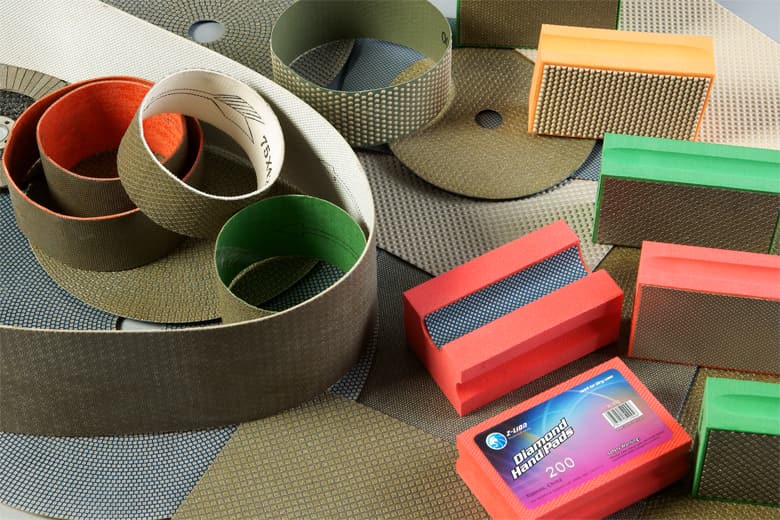
Electroplated Diamond Hand Pads and Drum Wheels
Hand pads and drum wheels offer distinct advantages when working on curved surfaces, corners, or hard-to-reach areas. They are suitable for detailed finishing, especially where machining equipment cannot easily access.
Custom OEM Diamond Abrasives
Aerospace machining often requires custom sizes, grit combinations, substrate types, and specialized configurations. For specific radii, laminated materials, or narrow contact areas, custom tools can significantly improve efficiency and consistency.
Why Z-LION Electroplated Flexible Diamond Tools Stand Out
Z-LION specializes in electroplated flexible diamond abrasives. Its nickel electroplating process emphasizes higher grain exposure to deliver greater cutting force and smoother chip evacuation. To learn more, explore diamond sand belt product solutions.
Step-by-Step Selection Guide:
First, consider the material: carbon fiber, fiberglass, coated, or high-resin surfaces
Next, consider the process: grinding, deburring, chamfering, or finishing
Select the tool type: Choose sanding belts for large-area contact, discs for open surfaces, and hand pads or drum wheels for detailed areas
Balance efficiency and surface finish: Don’t just pursue high removal rates
Assess the risk of clogging: If traditional abrasives clog easily, prioritize testing electroplated diamond solutions
Conclusion
The most suitable diamond tool for the aerospace industry is not simply the sharpest tool, but one that truly solves machining challenges. If your current abrasives are prone to clogging, produce inconsistent edge quality, or slow down finishing cycle, it is worth reevaluating electroplated flexible diamond solutions.
When comparing options, focus on the following key questions:
Does the tool match the material?
Does it reduce clogging?
Does it help improve edge quality and reduce rework?
Is the workpiece geometry better suited for flexible tools?
Do you need standard or custom products?
If you would like recommendations based on material, process, and desired results, please contact Z-LION directly for a quote and selection support.
FAQs
What processes are diamond tools primarily used for in the aerospace industry?
Diamond tools are primarily used for grinding, deburring, trimming, shaping, and surface finishing. Common applications include turbine blade cleaning, composite edge processing, coating removal, and localized repair work.
Why are diamond tools suitable for aerospace composite machining?
Because diamond tools offer sharper cutting edges and are less prone to clogging on high-resin materials. As a result, they help achieve cleaner edge and consistent machining performance.
What are the common types of diamond tools used in aerospace applications?
Common types include electroplated diamond abrasive belts, discs, blades, hand polishing pads, drum wheels, and OEM custom abrasives.
Can diamond tools improve finishing efficiency in aerospace applications?
Yes. In many applications, diamond tools can improve cutting efficiency, reduce clogging, and provide more consistent surface quality. As a result, they help reduce rework and improve overall machining efficiency.
How do you select the right diamond abrasive for aerospace applications?
You should identify the material and process at first, then select the appropriate tool form, cutting intensity, and surface finish grade. If the part has a complex shape or the material easily clogs with standard abrasives, electroplated flexible diamond tools are usually worth testing first.
Post time: Dec-15-2022