
Creating professional bullnose tile edges requires high-quality tools and precise techniques. As a contractor or tile specialist, you know the importance of a perfect finish. Mastering this skill will directly improve the quality of your projects and customer satisfaction. Improper edge finishing looks unprofessional and can easily lead to chipped tile edges.
Our comprehensive guide provides precise steps to help you efficiently shape and polish your tiles. First, we’ll explore the essential tools needed to complete this task. Next, we’ll break down the specific procedures for different tile materials. If you encounter unique material challenges on-site, we recommend consulting our tool experts for customized advice.Ultimately, you’ll learn how to achieve a factory-grade, flawless finish on any project.
What Is a Bullnose Tile Edge
Understanding the exact profile you need is the first step toward success. Therefore, choosing the correct profile type will impact both the aesthetics and safety.
Definition of a Bullnose Edge
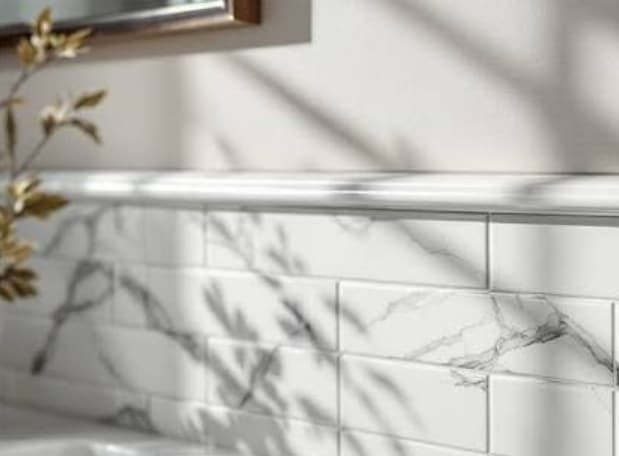
A bullnose tile edge refers to a smooth, curved finish applied to the edge of a standard tile. Installers use this curved profile to eliminate sharp right angles. As a result, the rounded edge provides a smooth, safe transition when tiles meet other surfaces. This process removes the raw, unglazed edges of the tile. Ultimately, a finished bullnose edge blends seamlessly into your overall design.
Types of Bullnose Tile Edges
Different projects require specific edge profiles. Typically, professionals use two main variations.
The first is the half bullnose, which features a curved top edge while the bottom remains flat. The second is the full bullnose, which forms a complete semicircle along the entire edge of the tile. Sometimes, you may want to consider alternatives to bullnose tile edges. For example, metal edge trims or mitered edges offer a more modern, angular look. However, the classic bullnose tile edging remains the standard for traditional safety and durability.
Where Bullnose Tile Edges Are Used
You’ll find these curved edges in a wide range of residential and commercial applications. Here’s a quick breakdown of common application areas.
| Application Areas | Primary Function | Ideal Profile Types |
|---|---|---|
| Baseboards | Protects walls from scratches and moisture. | Half Bullnose |
| Stair Treads | Eliminates sharp corners to reduce the risk of injury. | Full Bullnose |
| Countertop | Creates a smooth, comfortable work surface. | Full Bullnose |
| Shower Niche | Eliminates sharp corners and enhances waterproofing at the seams. | Half Bullnose |
| Pool Edges | Provides a safe grip area for swimmers. | Full Bullnose |
Tools Needed to Create a Bullnose Tile Edge
You need the right equipment to achieve a perfect finish. Therefore, choosing high-quality bullnose tile edge tools is non-negotiable for professionals.
Diamond Profile Wheels
The diamond shaping wheel mounts directly onto an angle grinder. First, it aggressively removes excess material. Next, it grinds the tile into the desired curve. You must match the wheel’s radius to your tile thickness.
Diamond Sanding Sponge
For fine-tuning and smoothing, a professional diamond sponge is essential. We strongly recommend using the Z-LION V30 Full Bullnose Diamond Shaping Sponge Wheel to complete the finishing touches. This specialized tool utilizes our advanced electroplating process. As a result, it delivers aggressive cutting power without clogging easily. Additionally, its flexible sponge backing conforms perfectly to the curve of the tile’s rounded edge. Therefore, it effortlessly removes deep scratches left by the metal grinding wheel.
Diamond Polishing Pads
After shaping, you must restore the tile to its factory shine. To do this, you’ll need a set of resin bond diamond polishing pads with a progressive grit sequence. You should always start with a coarse grit and gradually transition to finer grits.
Variable-Speed Polisher
Never use a high-speed angle grinder for polishing. Instead, you must use a variable-speed polisher. Lower speeds prevent the tiles from burning or cracking during the finishing process.
Can Any Tile Be Made Into a Bullnose Edge
Most solid tiles can be profiled. However, different materials require different methods.
Ceramic Tile
Creating a bullnose edge on ceramic tiles requires extreme care. The clay body is relatively soft, but the surface glaze is very brittle. Therefore, apply gentle pressure to avoid chipping the colored glaze.
Porcelain Tile
Porcelain tiles are extremely dense and have a uniform structure. As a result, they are well-suited for edge profiling. You’ll need to use a sharp, electroplated diamond tool to efficiently cut through this hard material.
Marble Tile
Marble is relatively soft. As a result, it can be shaped very quickly. However, marble is also easily scratched. Therefore, you must take more time to gradually increase the grit size of your polishing media.
Granite Tile
Granite is known for its hardness. First, you must always use water to cool the diamond tool. Second, reduce your feed rate. Rushing the process will damage both the stone and your equipment.
Quartz Tile
Quartz contains artificial resins. Because of this, high temperatures can cause the resin to melt and leave burn marks. Therefore, wet polishing is absolutely essential for quartz bullnose tile edging.
How to Shape a Bullnose Tile Edge
Please follow this step-by-step guide to efficiently shape tile edges.
Secure the Tile: First, clamp the tile firmly to the workbench. Make sure the edge is slightly overhanging.
Install the shaping wheel: Next, mount the correct diamond wheel onto the variable-speed angle grinder.
Grind the Edge: Start the angle grinder at a medium speed. Then, move the wheel smoothly along the tile edge.
Check the Curve: Wipe away any dust. Then, check that the curve is even.
Refine the Contour: Finally, use a electroplated diamond sponge to smooth out any ripples.
How to Polish a Bullnose Tile Edge by Hand
Manual polishing is ideal for touch-ups or working with fragile ceramic tiles. First, prepare a set of electroplated diamond hand polishing pads. Start with 60 grit to remove deep scratches. Next, move the hand-polishing pad back and forth along the curve.
Always keep the tile surface slightly wet. This allows water to flush away debris and prevent the tool from clogging. Afterward, switch to a 120 grit pad. Work through successive grits up to 400 grit to achieve a matte finish. Finally, thoroughly clean the edge to reveal a perfectly smooth, rounded tile edge.
Perfecting Your Next Tile Edging Project
Creating the perfect bullnose tile edge requires precision, patience, and the right abrasives. By following these steps, you can confidently tackle any custom edge-finishing task. Remember, the quality of your work depends entirely on the tools you use. Upgrading to professional electroplated diamond tools can save you time and reduce material waste. If you’re ready to equip your team with industry-leading abrasive tools, contact our sales team for an exclusive quote today.
FAQs
How to finish tile edges with bullnose?
First, use a diamond profile wheel to shape the rough edges. Next, use a matching profiled diamond sanding sponge to smooth out the grinding marks. Finally, polish the curved surface with diamond polishing pads until its gloss matches the original factory glaze.
Where bullnose tile edges are used?
Professionals primarily use these rounded edges for safety and aesthetic reasons. You’ll typically see them on baseboards, stair treads, shower niches, window sills, and kitchen countertops.
Can I repair a damaged bullnose tile edge?
Yes, minor chips are usually repairable. You can fill small imperfections with color-matched epoxy. Afterward, you must carefully sand the epoxy flush using a fine-grit diamond hand-polishing pad.
What grit should I use for bullnose tile polishing?
You must use a series of grits to achieve the proper gloss. Typically, you should start with 50 grit to remove scratches. Then, proceed sequentially through 100, 200, 400, 800, and 1,500 grit, up to 3,000 grit to achieve a high-gloss, mirror-like finish.
Post time: Jul-03-2026