
When tackling demanding machining projects, choosing the right abrasive directly determines your productivity and the final surface quality. Therefore, it is crucial to have a thorough understanding of the differences between electroplated vs resin bond diamond pads for any professional contractor or fabricator. If you choose the wrong pad, you may risk burning the material, wasting labor hours, or ruining the finish.
To address this, this guide will clearly explain how these two diamond pad types perform under pressure. We’ll provide a detailed analysis of their manufacturing processes, key advantages, and specific applications. After reading this article, you’ll know exactly when to use electroplated or resin bond pads. If you need to boost your cutting efficiency immediately, feel free to browse our complete line of electroplated diamond tools for solutions.
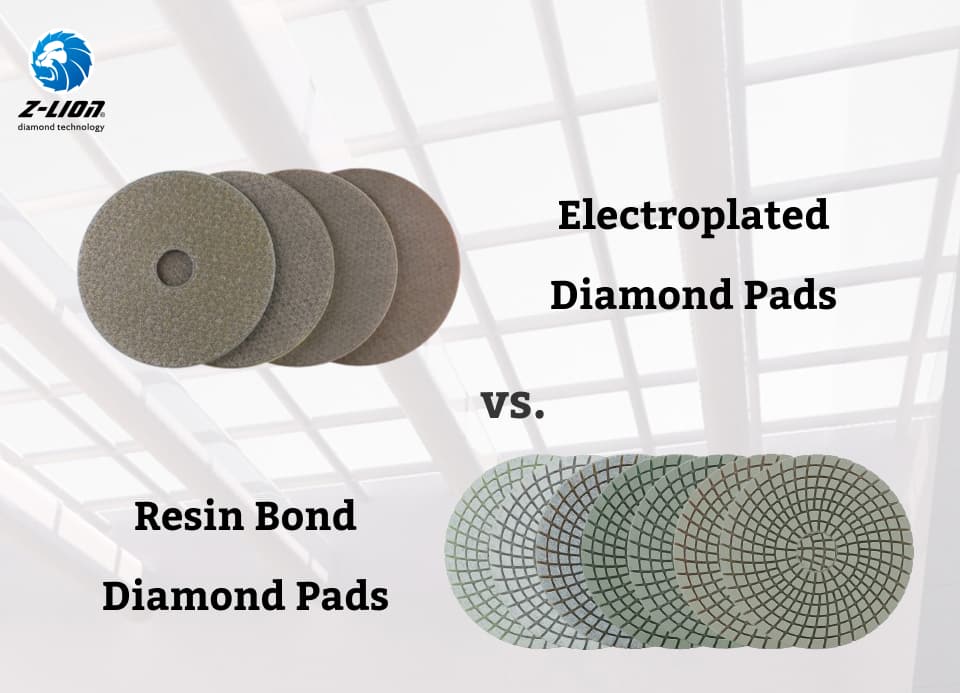
Electroplated vs. Resin Bond Diamond Pads at a Glance
Before delving into the technical details, you’ll need a general understanding of the differences between these two types of tools. That’s why we’ve compiled this actionable reference guide.
Quick Comparison Chart
| Feature | Electroplated Diamond Pads | Resin Bond Diamond Pads |
|---|---|---|
| Bonding method | Nickel alloy electroplating | Synthetic resin bond |
| Diamond exposure | Nearly 100% exposed | Partially embedded |
| Cutting speed | Extremely fast and aggressive | Slow, controlled material removal |
| Surface finish | Rough to medium | Smooth to high-gloss |
| Lifespan | Shorter (single layer) | Longer (multiple layers) |
| Heat resistance | Excellent (rapid heat dissipation) | Medium (may cause material burn at high speeds) |
| Cost | High initial cost, lower labor cost | Low initial cost |
| Typical applications | Edge profiling, composites, heavy stock removal | Scratch refinement, final honing, polishing |
What are Electroplated Diamond Pads
Electroplated diamond pads offer unmatched aggression and cutting speed. Specifically, manufacturers design these tools to handle heavy material removal without clogging or glazing.
How They are Manufactured
During production, we employ an advanced nickel alloy electroplating process. This method bonds a single layer of high-density diamond grains directly onto a flexible or rigid backing. As a result, the nickel matrix securely locks the diamond particles in place, preventing premature shedding during high-speed operation.
Key Advantages
Electroplated tools offer several significant advantages for industrial applications.
Rapid stock removal: Because the abrasive grains bite firmly into the workpiece, you achieve maximum cutting efficiency.
Ultimate sharpness: The single-layer structure ensures the diamonds remain completely exposed and extremely sharp.
Perfect for edge profiling and shaping: You can aggressively shape rigid materials without deforming the tool. Additionally, these tools excel at clearing debris when machining composite materials such as carbon fiber or glass fiber, preventing clogging.
Typical Applications
You should use electroplated grinding pads when working with super-hard coatings, glass, ceramics, and stone with complex contours. Furthermore, they are the essential choice for composite materials, where traditional abrasives are prone to clogging and failure.
What are Resin Bond Diamond Pads
Resin bond diamond grinding discs are the industry standard tools for achieving flawless, mirror-like finishes. Unlike high-cut tools, these discs focus on gradual scratch refinement.
How Resin Bond Pads Work
Manufacturers produce these grinding pads by mixing diamond powder uniformly into a synthetic resin matrix. As you operate the tool, friction gradually wears away the resin. Consequently, this controlled wear process continuously exposes fresh, sharp diamond particles to the work surface.
Key Benefits
Resin bond pads offer exceptional control when you move into the surface finishing stage.
Smooth polishing: The embedded diamonds in the resin create a shallow scratch pattern, resulting in a smooth, refined surface.
Longer service life: Because multiple layers of diamonds are distributed throughout the entire thickness of the tool, its service life is significantly longer than that of single-layer tools.
Superior gloss enhancement: The resin matrix itself helps create high-gloss polished surfaces on both natural and engineered stone.
Typical Applications
You will primarily rely on resin pads for flat polishing, fine grinding, and the removal of final scratches on materials such as granite, marble, and concrete.
Electroplated vs. Resin Bond Diamond Pads: Key Differences
To optimize your workflow, you must understand the key technical differences between electroplated and resin bond diamond pads.
Material Removal Speed
Electroplated diamond pads have a clear advantage in terms of speed. Because the diamonds protrude significantly from the nickel substrate, they aggressively tear away material. In contrast, resin pads remove material slowly, with their primary focus on smoothing the surface and eliminating existing scratches.
Surface Finish Quality
Resin grinding pads excel in surface finish. They produce a highly refined, polished surface. In contrast, electroplated pads create deeper scratches due to their powerful cutting action, resulting in a textured, matte, or honed finish.
Tool Life
Thanks to their extremely deep diamond working layer, resin pads have a longer overall service life. Electroplated pads contain only a single layer of diamonds. Therefore, once this abrasive layer wears down and becomes flat, you must replace the tool.
Diamond Exposure
Electroplated pads boast nearly 100% diamond exposure. This high exposure prevents heat buildup and avoids tool dulling and slippage. In contrast, resin bond grinding discs expose only a very small proportion of their diamond grains at any given time.
Heat Generation
The nickel plating on electroplated grinding discs dissipates heat rapidly. As a result, you can perform dry cutting at higher speeds without burning the material. resin bond grinding discs have insulating properties, which means you must carefully control the speed or use water cooling to prevent scorching of the surface.
Flexibility
Both pads are available in flexible versions. However, flexible electroplated grinding discs typically feature a dot or square design to bend around tight radii without cracking the nickel bond. Resin bond grinding discs, on the other hand, naturally possess good flexibility due to the softer binder material.
Cost and Value
Although electroplated polishing pads have a higher initial purchase cost, they reduce labor time during heavy polishing. Resin bond pads cost less per unit and offer excellent long-term value for continuous polishing tasks. If you are evaluating a detailed comprehensive comparison of diamond polishing pads, be sure to consider both tool life and labor savings.
When Should You Choose Electroplated Diamond Pads?
When your primary goal is rapid shaping rather than final polishing, you should definitely choose electroplated diamond polishing pads.
Fast Material Removal
Choose these discs when you need to quickly level high spots, remove thick coatings, or smooth uneven surfaces. They will save you hours of grinding time.
Edge Shaping and Profiling
When carving edges, creating bullnose edges, or chamfering hard stone, the rigid cutting action of electroplated grinding discs perfectly maintains the tool’s shape.
Removing Saw Marks
Deep saw marks require aggressive tools to tackle. That’s why electroplated pad can eliminate these deep gouges faster than coarse grit resin pads.
Difficult-to-Reach Areas
For tight corners and complex contours, flexible electroplated hand polishing pads provide sufficient cutting bite to help you shape material in areas that heavy machinery cannot reach.
When Should You Choose Resin Bond Diamond Pads?
Once heavy-duty shaping and rough grinding are complete, you should immediately switch to resin bond diamond pads.
Scratch Refinement
Use resin discs in sequence (from 50 grit up to 3,000 grit) to systematically remove deep scratches left by electroplated or metal bond tools.
High-Gloss Polishing
If your project requires a mirror-like finish, resin bond diamond pads are essential. The resin matrix effectively helps polish the surface to a brilliant shine.
Final Surface Finishing
For interior flooring, high-end countertops, and decorative pieces, resin grinding discs deliver the flawless, smooth finish that customers expect.
Continuous Production
Whether used in automated polishing lines or large-scale floor grinding operations, the extended service life of resin bond grinding discs ensures you face fewer tool changeovers.
Optimizing Your Pad Selection Strategy
Ultimately, the debate of electroplated vs resin bond diamond pads is not about which tool is better, but rather which tool is best suited for the specific processing stage at hand. You should use electroplated pads for rapid shaping, heavy material removal, and machining difficult composites. Then, switch to resin bond pads to achieve a fine, high-gloss final surface. By scientifically combining these two technologies, you’ll maximize your production speed and deliver exceptional results.
If you’re ready to upgrade your machining toolkit and eliminate downtime entirely, feel free to browse our high-performance electroplated diamond tools or contact our engineering team to discuss customized solutions for your specific application.
Frequently Asked Questions
What is the main difference between electroplated and resin bond diamond pads?
The main difference lies in the bonding process. Electroplated pads use a nickel coating to secure a single, highly exposed layer of diamonds for powerful cutting. Resin bond pads, on the other hand, embed diamonds in a plastic-like resin matrix, which wears down gradually to provide a smooth polishing finish.
Can electroplated and resin bond diamond pads be used together?
Yes, professionals typically use them in sequence. You first use electroplated pads for rapid shaping, edge chamfering, and removing coarse scratches. Afterward, you switch to resin pads to refine the surface and perform the final polish.
Which diamond pads remove material faster?
Electroplated diamond pads remove material significantly faster. Because nearly 100% of the diamond particle are exposed, this tool tears deeply into the substrate, making it ideal for heavy material removal.
Which diamond pads are best for granite and quartz?
Electroplated diamond pads are the best choice for edge shaping on granite and quartz. However, to polish the flat surfaces of these hard stones and achieve a high-gloss mirror finish, you must use a sequence of resin bond diamond pads.
Post time: Aug-14-2026