
When you cut and polish granite undermount sink profiles, precision directly determines your professional reputation. Chipped edges or uneven cutouts can easily ruin an expensive slab. Therefore, you need a systematic approach and reliable tools to execute this task.
First, you must understand how to properly sequence the steps for cutting, shaping, and polishing. By doing so, you’ll maximize efficiency and deliver a perfect fit for the basin. Choosing high-performance electroplated diamond tools can prevent chipping and speed up your workflow. Next, we’ll walk you through the key steps for completing this critical task.
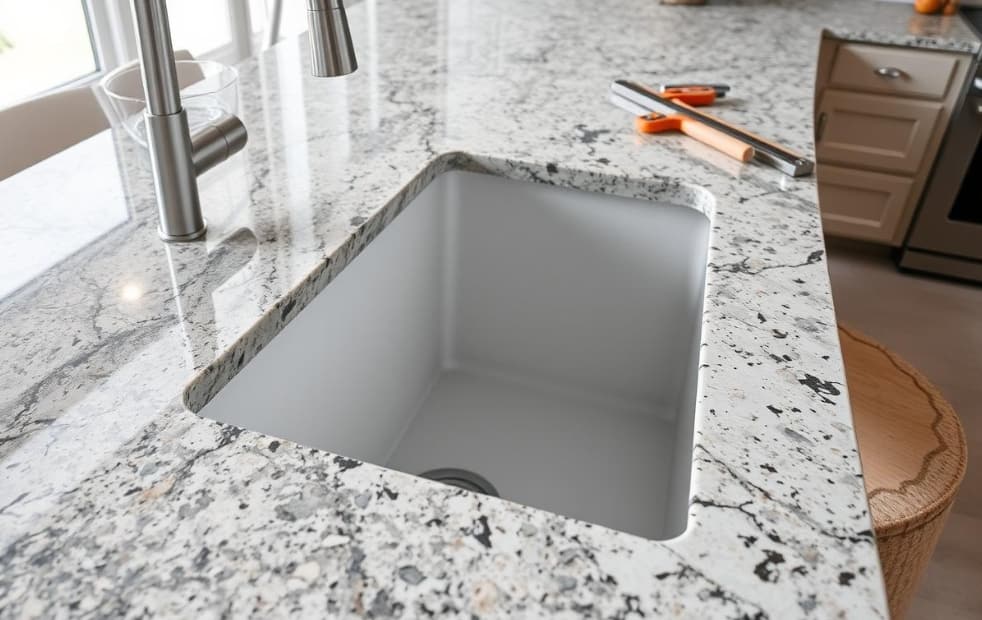
What You’ll Need Before Cutting a Granite Sink Opening
Before beginning the machining process, you must have the correct equipment ready. Having the right tools on hand ensures you can safely and efficiently complete the granite countertop sink opening.
Essential Tools
You’ll need a specific set of tools to carry out the entire workflow. Each tool plays a unique role in the process.
Diamond saw blade: This tool is used for the initial rough cut of the slab.
Diamond drum wheel: You can use this to grind away excess material and shape the final cutout.
Diamond polishing pads: These pads refine the edges and create the final high-gloss finish.
Angle grinder: Powers your cutting and grinding accessories.
Measuring template: Used to guide your initial layout.
Water supply: Wet grinding prevents dust and extends tool life.
Step 1: Cut the Granite Sink Opening
You must approach the initial cut with caution. A careful rough cut prevents structural damage to the granite slab.
Mark the Sink Template Accurately
First, position the manufacturer’s template on the granite slab. You must secure it firmly to prevent shifting. Next, trace the outline using a high-visibility marker. Be sure to double-check all dimensions before proceeding. This will help you avoid costly alignment mistakes later.
Make the Initial Cut with a Diamond Saw Blade
Now, you will begin cutting the granite sink cutout. First, drill a starter hole at the corner of the template line. Next, insert the diamond saw blade and cut slowly along the straight line. You must maintain a steady speed to prevent chipping the fragile corners. Plunge cuts require extra care to prevent stress fractures in the stone.
Leave a Small Margin for Final Shaping
It is crucial that you never cut directly on the final template line with your saw blade. Instead, leave approximately 1–2 millimeters of material inside the line. This buffer zone protects the final edge from saw blade blowouts. Furthermore, it leaves the perfect amount of material for final finishing. This strategy sets up the next step perfectly.
Step 2: Shape the Sink Cutout with a Diamond Drum Wheel
This step determines the final quality of your granite undermount sink cutout. Stone shaping requires powerful yet controlled grinding.
Why a Drum Wheel Is Better Than Cutting to Final Size
Many fabricators ruin the slab by attempting to cut precise corners directly with a saw blade. Overcutting leads to structural weakness and unsightly seams. Therefore, using a diamond drum wheel for granite sink opening provides far superior control. A drum wheel can easily grind away the remaining 1–2 millimeters of material without the risk of catastrophic chipping.
Remove Saw Marks and Smooth the Inner Edge
Your initial cut will leave deep scratches and blade marks. Next, you’ll need to mount a electroplated diamond drum wheel on an angle grinder. Run the drum wheel along the inner edge of the cutout. The abrasive surface will vigorously remove the blade lines. As a result, it smooths out uneven edges and prepares the surface for the final polish.
Fine-Tune the Sink Opening
You must ensure that the sink basin fits perfectly into the hole. The drum wheel allows you to fine-tune the opening with extreme precision. First, you can slightly enlarge the cutout if necessary. Second, you can correct any minor errors in the template tracing. Finally, you can use the drum wheel to create consistent and perfectly smooth corner transitions.
Step 3: Polish the Granite Sink Cutout
Once you’ve achieved the perfect shape, you must refine the edges. Smooth, polished inner edges are a mandatory requirement for undermount sinks.
Round Over or Ease the Edge
First, you must address the sharp edges at the top of the cutout. A sharp 90-degree angle chips easily during daily use. Therefore, use a profile wheel or the low grit polishing pad to ease the edges. Creating a slight rounding not only protects the granite but also makes it feel smoother to the touch.
Polish Through Successive Grits
Now, you’ll begin the process of polishing the granite sink edges. You’ll use flexible diamond polishing pads to complete this task. Start with a 50 grit polishing pad to remove grinding marks left by the drum wheel. Next, progress systematically through 100, 200, 400, 800, 1,500, and 3,000 grits. Never skip any grit size. Ultimately, you’ll achieve a factory-grade high gloss that matches the top of the countertop.
Conclusion
Successfully executing a granite sink opening requires skill and the best abrasives. When cutting and polishing undermount granite sink profiles, tool quality directly impacts your labor costs. Using high-quality electroplated tools ensures exceptionally sharp cuts and maximum efficiency. As a result, you can complete the job faster and eliminate expensive slab replacments. If you want to speed up your fabrication process, we can help. Get a quote for our diamond drum wheels today and experience exceptional shaping performance on your next project.
FAQs
Can a drum wheel enlarge a sink opening?
Yes. High-quality diamond drum wheels have powerful material removal capabilities. Therefore, they are the perfect tool for safely enlarging the cutout by a few millimeters to fix a tight fit.
What grit drum wheel should I use first?
To remove material quickly after the initial cut, you should start with a coarse grit. A 50 or 30 grit electroplated drum wheel provides the strongest cutting power, allowing you to quickly remove saw marks.
Can I polish a granite sink cutout without a drum wheel?
Technically, you can use a low grit polishing pad to smooth the edges. However, this method is extremely time consuming and will quickly wear out your polishing pad. Therefore, you should always use a drum wheel to remove excess material before polishing.
Post time: Aug-28-2026