
Raising and sanding are essential mechanical finishing processes in textile manufacturing. They significantly enhance the feel and appearance of fabrics. As such, they are particularly critical for materials like denim, wool, and microfiber. Because these fabrics often require a soft and velvety surface to meet customer expectations. Although traditional abrasives have been the industry standard for decades, results are often inconsistent and can cause fiber damage.
Therefore, upgrading to diamond sanding belts is a superior alternative. This type of diamond tool provides a precise, and durable abrasion required for high-quality fabric finishing.
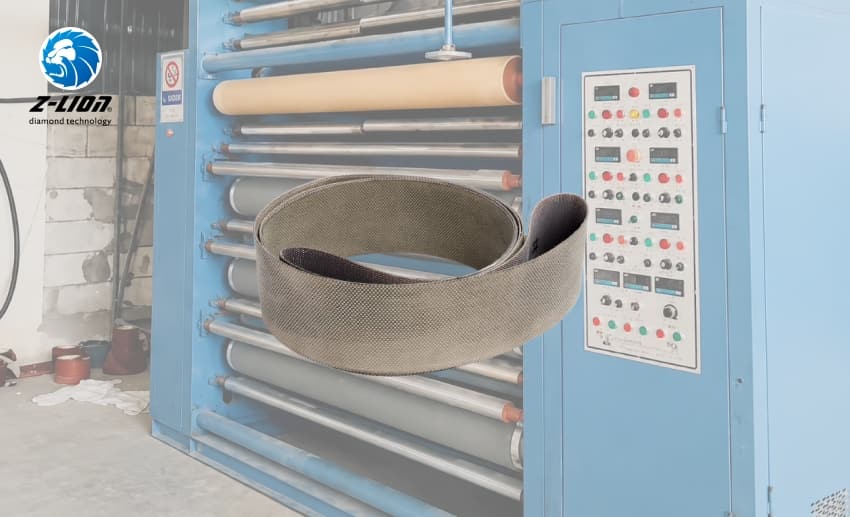
What is Fabric Sanding and Raising?
Fabric finishing aims to transform raw woven materials into more comfortable and premium products. Brushing, also known as raising, involves using rotating brushes or rollers to lift fibers from the fabric surface. This process creates a fluffy texture that enhances warmth and comfort. In contrast, sanding, or diamond sanding, lightly abrades the fabric to create a more uniform and softer finish, improving the appearance and feel.
Challenges of Traditional Sanding in Textile Manufacturing
Before advanced abrasives, textile manufacturers usually relied on sandpaper and emery cloth. While these traditional abrasives are widely available, they present a series of challenges that limit production efficiency.
Create Uneven Surfaces
Traditional sanding belts usually wear unevenly, producing inconsistent scuff marks on fabric surface. Some areas become rough due to over sanding, while others remain under treated. This lack of consistency leads to serious quality control issues and increases the risk of customer returns.
Weaken and Break Fibers
High grinding force from traditional abrasives can break or weaken fibers, reducing the overall durability and leading to issues like pilling. At the same time, the fabric may lose key characteristics, such as breathability and moisture management.
Wear Out Fast and Cost More
Aluminum oxide and silicon carbide belts typically have a short service life and require frequent replacement. Continuous replacement not only drives up direct production costs but also leads to increased downtime. Ultimately, it will impact the factory profitability.
Lack Precision and Control
Traditional methods often require repeated manual adjustments to maintain consistent results. Operators must frequently stop the machine to check and fine-tune parameters; such time-consuming manual interventions slow down the production line and increase the likelihood of human error, making on-time delivery more difficult.
Actionable Insight: Traditional vs. Diamond Belts
| Feature | Traditional Emery Belts | Diamond Abrasive Belts |
|---|---|---|
| Wear Rate | Fast but uneven | Extremely slow and consistent |
| Effect on fibers | Tears and weakens fibers | Clean cut that maintains strength |
| Service life | Short, frequent replacement | 5 to 10 times longer |
| Clogging | High risk | Low risk, excellent chip removal |
Why Diamond Abrasive Belts are the Smarter Solution
Diamond technology represents a major upgrade. Through an advanced nickel alloy plating process, high-quality electroplated diamond abrasive belts achieve a higher proportion of exposed diamond particles. While maintaining efficient chip removal, they also provide stable and powerful cutting force.
Provide a Perfectly Uniform Finish
Diamond particles are evenly distributed across the entire belt, which ensure consistent material removal and prevent uneven pile height. Additionally, these belts are highly resistant to clogging, maintaining stable performance even during extended runs.
Cut Fibers Cleanly Without Damage
The interaction between the abrasive and the fibers is critical. Diamond particles possess extremely sharp and hard edges, allowing them to process fibers in a more cutting manner rather than tearing roughly. This better preserves the strength. Ideal for stretch denim and fine functional materials, reducing fiber damage.
Customizable Gravel with Different Finishes
Diamond sanding belts offer a wide range of grit sizes. They allows precise matching to production requirements and customization of finishing processes.
Quick Grit Selection Guide:
Coarse grit (60-120#): Suitable for heavy-duty grinding, commonly used on fabrics requiring strong finishing effects, such as stone-washed denim.
Medium Grit (150-220#): Suitable for standard raising and brushing, commonly used for wool jackets, striking a balance between softness and durability.
Fine Grit (300-600+#): Designed for ultra-soft finishes, suitable for delicate fabrics such as microfiber blankets.
Last Longer and Save You Money
With a longer service life, diamond abrasive belts represent a more cost effective investment. Their lifespan is typically 5 to 10 times longer than that of traditional abrasive belts, helping to reduce replacement frequency and downtime.
Diamond Abrasive Belts in Action Real World Examples
Electroplated diamond abrasives offer advantages across textiles. Selecting the appropriate tools and grit sizes helps maximize product quality and competitiveness.
Creating Soft and Durable Denim
The finishing of denim largely determines the appearance and texture of the finished garment. Diamond abrasive belts ensure a more uniform surface finish. Compared to traditional abrasives, they provide a cleaner cut, minimizing fiber loss.
Enhancing Softness in Wool and Microfiber
Consumers have high expectations for the softness of wool coats and microfiber home textiles. Precision diamond grinding creates a finer, velvety-smooth texture while preserving the fabric’s original structure and shape and enhancing its tactile feel.
Refining Technical and Sportswear Fabrics
Sportswear fabrics must meet strict performance standards. Diamond sanding belts enable finer surface texturing while minimizing damage to the fabric’s functional properties. For example, they perform sanding with gentler, controlled friction, reducing the impact on performance features such as moisture-wicking. This helps produce more durable fabrics suitable for high-intensity athletic activities.
Upgrade Your Textile Production With Diamond Tools
Diamond abrasive belts offer exceptional performance and control for modern fabric finishing. From ensuring uniform brushing of denim to improving the hand feel of high-performance sportswear, these tools deliver consistent precision. By reducing uneven wear, minimizing fiber damage, and shortening downtime caused by consumable changes, manufacturers can significantly improve efficiency.
Z-LION Diamond Tools specializes in high-quality electroplated flexible diamond abrasives that offer exceptional durability and cutting power. If you are planning to upgrade your textile finishing processes, we invite you to request a quote for diamond sanding belts today and consult with our experts about factory-specific pricing and customized OEM solutions.
Post time: May-16-2025