
Choosing between a diamond cloth disc vs diamond sanding belt directly impacts your surface finish, cycle time, and tooling costs. When machining thermal spray coatings, composites, or ceramics, the wrong abrasive can lead to premature loading, uneven cutting, or heat damage.
Understanding the mechanical differences in diamond cloth discs and diamond sanding belts will help you select the right tool for your equipment. To explore industrial products designed for efficient material removal, browse our full range of flexible diamond abrasives.
What are Diamond Cloth Discs and Diamond Sanding Belts
Both tools belong to the flexible diamond abrasive family. However, they differ in physical geometry, bond systems, and motion mechanics.
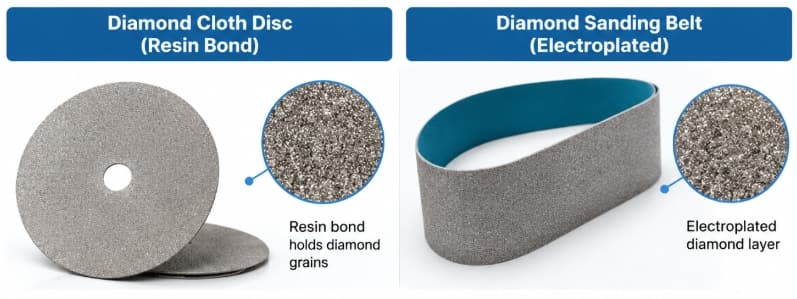
What is a Diamond Cloth Disc
A diamond cloth grinding disc is a circular grinding tool manufactured on a durable cloth backing. Unlike rigid grinding wheels, this flexible backing allows the disc to conform slightly to contours without gouging.
Bond Structure: Industrial diamond cloth discs typically use a resin bonded matrix. This bond securely holds synthetic diamond particles while continuously wearing fresh cutting edges.
Operation: You can mount the disc onto a rotating pad using a hook-and-loop or PSA system. It operates through high-speed rotational motion.
Main Applications: You use these discs for localized grinding, precision finishing, edge chamfering, and dimensioning on hard, brittle materials.
What is a Diamond Sanding Belt
A diamond sanding belt is a closed-loop tool made from a heavy-duty cloth or polyester backing coated with industrial diamonds.
Bond Structure: High-performance diamond sanding belts rely on an electroplated nickel bond. This process securely locks a single diamond layer onto the backing with high exposure, maximizing cutting sharpness and chip clearance.
Operating Principle: The belt runs continuously over rollers on a belt grinder. This allows the abrasive surface cools down between contact passes.
Main Applications: You can use these belts for continuous grinding, rapid material removal over large areas, cylindrical grinding, and high-throughput production lines.
Diamond Cloth Disc vs Diamond Sanding Belt: Key Differences
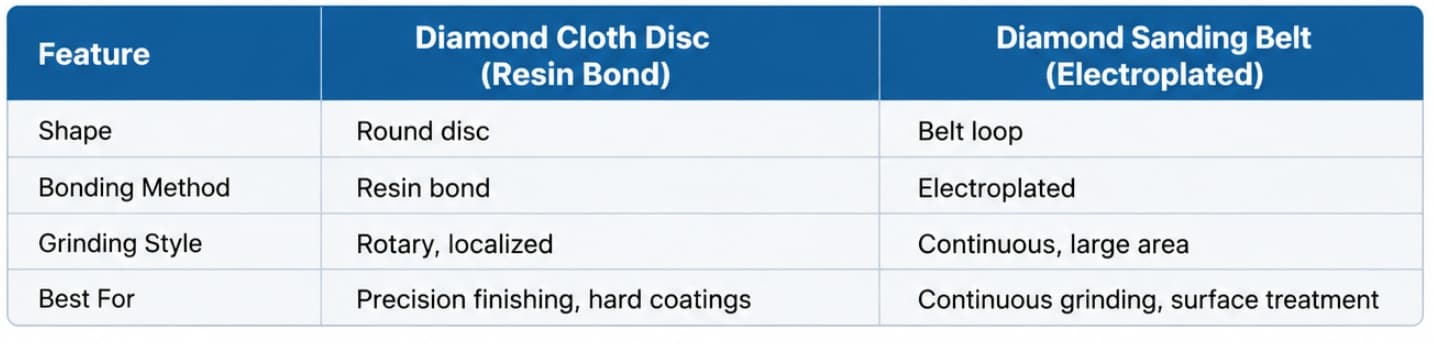
To evaluate a diamond cloth disc versus diamond abrasive belt, it is necessary to compare their operating mechanisms across key production dimensions.
| Features | Diamond Cloth Disc | Diamond Sanding Belt |
|---|---|---|
| Physical Shape | Flat circular disc | Closed-loop continuous belt |
| Typical Bonding Agent Systems | Resin bond diamond | Electroplated diamond |
| Motion Type | Rotational / orbital | Linear continuous loop |
| Heat Dissipation | Moderate (continuous contact) | High (cooling during return cycle) |
| Best Applications | Localized precision finishing | High-speed continuous stock removal |
| Compatible Equipment | Angle grinders, rotary polishers, orbital sanders | Belt sanders, centerless grinders, backstand grinders |
Shape and Working Method
Diamond cloth discs concentrate cutting action within the circular footprint, where outer edges travel faster than the center. In contrast, diamond sanding belts maintain a uniform linear speed across their entire width. Additionally, the continuous circulation prevents localized heat buildup during prolonged grinding cycles.
Equipment Compatibility
The abrasive selection is often determined by your shop machinery. Diamond cloth discs can be easily mounted on handheld angle grinders, orbital sanders, and stationary rotary polishers. In contrast, diamond sanding belts require dedicated belt sanders equipped, backstand idlers, or wide-belt sanding systems with tensioning mechanisms.
Grinding Area and Processing Efficiency
When you need to repair localized defects or blend weld seams, the discs offer superior maneuverability. However, belts achieve higher material removal rates on large flat or cylindrical surfaces. At the same time, the belts’ larger surface area distributes wear evenly, reducing tool changeovers.
Surface Finish and Application Flexibility
Resin bond grinding discs excel at producing uniform, scratch-free finishes because the resin matrix acts as a buffer for the diamonds. Meanwhile, electroplated belts cut aggressively and resist clogging on gummy composites, though they leave deeper scratch patterns at equivalent grits.
Which One Is Better for Your Material and Application
There is no absolute superiority or inferiority. Rather, your workpiece material and the surface tolerances determine the best choice.
For Precision Finishing of Hard Coatings: Diamond Cloth Disc
When finishing thermal spray coatings, traditional abrasives dull instantly. Therefore, you need the extreme hardness of diamond combined with a resilient resin bond.
When finishing tungsten carbide, chromium carbide, silicon carbide, and ceramic thermal barrier coatings, diamond cloth discs provide exceptional control. The resin binder prevents microcracks on brittle surfaces while maintaining tight tolerances.
It is recommended to start with 60 or 120 grit for leveling, then gradually transition to 400 or 800 grit to achieve a precision finishing. For detailed technical specifications and available grit sizes, explore Z-LION diamond cloth discs for hard coated materials.
For Continuous Grinding: Diamond Sanding Belt
If your operations involve heavy cutting or automated contouring, sand belt systems can maximize productivity. Electroplated diamond sand belts perform well when grinding fiberglass, carbon fiber composites, stone slabs, glass edges, and hardened rollers.
Because electroplated diamonds sit proud of the nickel layer, swarf and composite dust clear rapidly without loading. When selecting a belt, match the backing weight (e.g., X-weight or Y-weight) to the grinding tension, and choose a grit between 40 and 100 for rapid shaping. You can compare different lengths, widths, and grits in our industrial diamond sanding belts.
How to Choose the Right Diamond Abrasive Tool
Follow this three-step selection guide to precisely match diamond abrasives to your workshop conditions:
Assess material hardness and brittleness: Determine whether your workpiece consists of a brittle thermal spray coating or a fibrous composite. For brittle ceramics and carbides requiring gentle finishing, choose resin bonded grinding discs; for composites, glass, and metals requiring heavy material removal, choose electroplated abrasive belts.
Match the grit size to surface requirements: Determine your target surface roughness (Ra). Use coarse grit (40–120) for heavy shaping, transition to medium grit (200–400) for smoothing, and finally use fine grit (800–3000 mesh) for precision polishing.
Verify machine parameters and coolant needs: Check the equipment’s maximum RPM or SFPM ratings, and confirm dry or wet compatibility. Wet grinding extends tool life and suppresses harmful dust on coatings and composite materials.
Conclusion
Choosing between diamond cloth discs and diamond sanding belts essentially involves striking a balance between precise force control and continuous removal rates. Resin bond cloth discs offer exceptional precision for localized finishing of superhard coatings, while electroplated abrasive belts are well-suited for high-volume, continuous grinding tasks without clogging.
Whether you need standard sizes or OEM custom solutions tailored to specific production lines, feel free to consult our technical experts or request a quote at any time to fully optimize your grinding process.
Frequently Asked Questions
Can a diamond cloth disc replace a diamond sanding belt?
No, diamond cloth grinding discs cannot fully replace diamond sanding belts in high-volume production. While discs excel at localized dressing and flat finishing, they lack the cooling loop and rapid removal efficiency of belts when on large workpieces.
Which is better for finishing hard thermal spray coatings?
A resin bond diamond cloth disc is typically better for finishing hard thermal spray coatings like tungsten carbide or ceramics. The resin matrix cushions the diamonds, preventing micro-cracking and ensuring tight dimensional accuracy.
Can diamond sanding belts be used for polishing?
Yes, you can use fine-grit diamond sanding belts to polish cylindrical parts, glass edges, and stone profiles. However, because most diamond belts use an electroplated bond, achieving a mirror polish requires stepping through fine grits with water cooling.
How do you choose the right grit for diamond abrasive tools?
Select the grit size based on material removal rate and the target surface finish. Coarse grit (40–120) is recommended for heavy cutting; medium grit (200–400) for routine smoothing; and fine grit (800+) for final precision surface finishing.
Post time: Nov-20-2026