
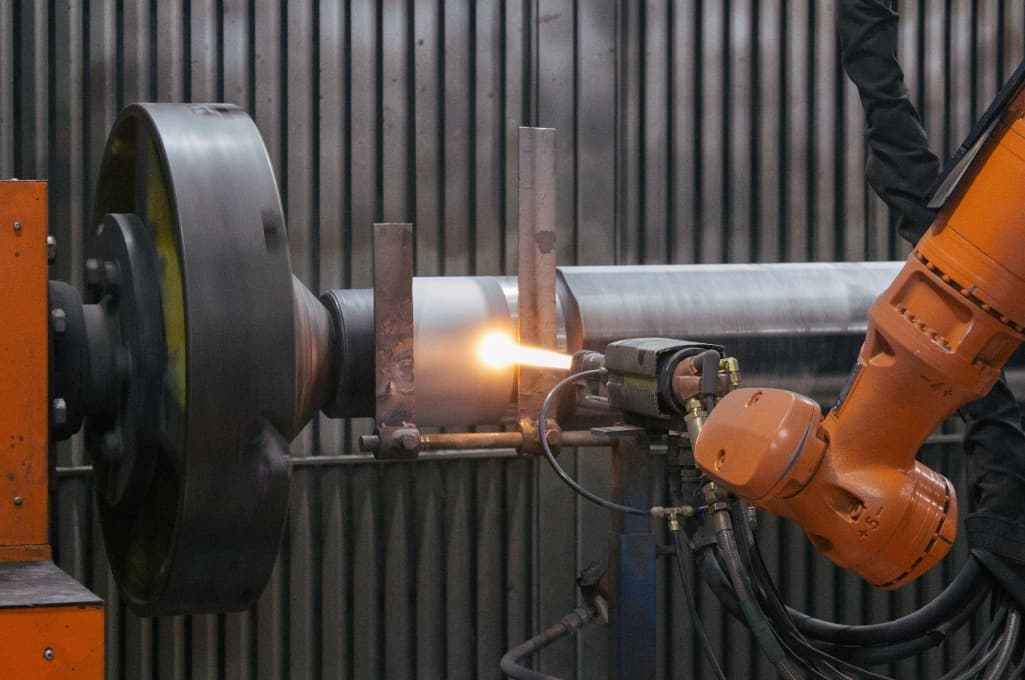
Thermal spray coatings finishing is a critical post-processing step in industries such as aerospace, oil and gas, power generation, and semiconductor manufacturing. Although these hard thermal spray coatings possess extremely hardness, wear resistance, and heat resistance, their initial “as-sprayed” surfaces typically do not meet the final engineering requirements. Therefore, you must further process them to achieve the precise dimensional tolerances and surface roughness required for the application.
Finding the right method is no easy task. This guide will show you how to select the best process and diamond abrasives for finishing hard thermal spray coatings. Thus, you’ll learn how to remove material efficiently while avoiding costly surface damage. If you’d like to learn more about our core abrasive technologies, explore our electroplated flexible diamond tools.
What Makes Thermal Spray Coating Finishing Challenging
Achieving a perfect thermal spray coatings surface finishing requires overcoming several significant material challenges. Conventional abrasives are often ineffective when working with these advanced surfaces.
High Hardness and Abrasion Resistance
Materials such as tungsten carbide (WC), chromium carbide (CrC), and silicon carbide (SiC) possess extremely high hardness. Consequently, this high hardness significantly reduces the material removal rate of traditional abrasives. You need specialized super hard abrasives to efficiently perform hard coating finishing.
Brittle Structure and Risk of Surface Damage
Hard thermal spray coatings typically contain inherent porosity and a layered matrix structure. Consequently, aggressive grinding can easily lead to severe surface defects in the thermal spray coating. Common issues include:
Surface chipping along part edges.
Particle detachment within the coating matrix.
Micro cracking beneath the surface.
Coating delamination from the base substrate.
Difficulty Achieving a Uniform Surface Finish
Inconsistent abrasive wear often leads to localized over-grinding. Furthermore, uneven pressure can cause deep scratches and result in inconsistent surface roughness. Therefore, maintaining stable abrasive contact is key to overall success.
How to Choose the Right Finishing Method and Abrasive
Before beginning the thermal spray coatings grinding, you must select the appropriate machining process.
Grinding vs. Lapping and Polishing
You should select the appropriate method based on the specific coating material, its initial state, and the final processing requirements.
| Method | Primary Purpose | Material Removal Rate | Optimal Applications |
|---|---|---|---|
| Grinding | Rapid stock removal and dimensional finishing | High | Shaping and achieving dimensional tolerances |
| Lapping | Improving flatness and contact area | Medium | Correcting minor geometric errors |
| Polishing | Achieving ultra-fine surface quality | Low | Eliminates microscopic scratches |
Why are Diamond Abrasives Suitable for Hard Coatings
Diamond abrasives for thermal spray coatings offer the highest hardness and wear resistance available today. Unlike aluminum oxide or silicon carbide, diamond can easily cut superhard carbides and advanced ceramics. In addition, it retains a sharp cutting edge for longer. This durability reduces the grinding heat buildup that typically causes thermal damage.
How to Choose the Right Abrasive Grit
The choice of diamond abrasive grit directly determines your finishing success.
Coarse grit (60–120): Used for aggressive initial material removal.
Medium grit (200–400): Used for surface transition and removing deep scratches.
Fine grit (800+): Used for final polishing and precise surface roughness control.
Be sure to adjust the grit size gradually, rather than jumping directly from the coarsest to the finest grit.
How to Finish Hard Thermal Spray Coatings Step by Step
Follow this standard procedure to perform precision grinding of hard coatings safely and efficiently.

Step 1: Evaluate the Coating and Required Surface Finish
First, thoroughly evaluate your workpiece before beginning any machining. You must confirm:
The exact coating material and its hardness.
The initial surface roughness baseline.
The required dimensional tolerance range.
The target surface roughness specifications.
The total coating thickness and substrate condition.
Step 2: Select the Appropriate Diamond Abrasive Tool
Next, select the tool based on the workpiece’s shape, surface area, and finishing objectives. For localized finishing, irregular contours, or precise dimensioning, flexible abrasive tools excel.
For example, our Z-LION diamond cloth discs for finishing and dimensioning of hard coated materials feature a highly durable resin bonded diamond abrasive structure on a flexible cloth backing. These discs easily conform to complex curved surfaces. Additionally, they are available in a variety of grit sizes and are suitable for both dry and wet grinding applications, ensuring consistent material removal on hard coating.
Step 3: Use Progressive Grits to Refine the Surface
Start with a grit size that matches your initial surface roughness. After completing the first pass, gradually transition to a finer grit size. This systematic approach effectively removes deep scratches left by the previous grinding operation.
Step 4: Control Grinding Pressure, Speed, and Heat
Operating parameters directly affect the integrity of your coating.
Avoid excessive grinding pressure to prevent immediate microcracking.
Maintain stable and consistent contact between the diamond tool and the workpiece.
Use the operating speed recommended by the manufacturer for your specific equipment.
Use an appropriate diamond grinding coolant to control friction and heat buildup.
Step 5: Inspect the Surface After Each Finishing Stage
Finally, carefully evaluate the workpiece between each grit change. Check surface roughness, look for residual scratches, identify any coating defects, and measure dimensional changes. Based on this, you can accurately determine when to proceed to the next finishing stage.
What are the Finishing Considerations for Different Thermal Spray Coatings
Different materials require slightly different approaches during the surface finishing of thermal spray coatings.
Tungsten Carbide and Chrome Carbide Coatings
Grinding tungsten carbide coatings requires abrasives with extremely high hardness due to the coating’s exceptional wear resistance. Similarly, finishing chromium carbide coatings also requires robust diamond abrasives to prevent premature tool wear. Always use sharp diamond tools to avoid excessive surface friction.
Silicon Carbide Coatings
Finishing silicon carbide coatings presents a unique challenge because the material is extremely hard and highly brittle. Therefore, you must apply precise and gentle pressure. Severe abrasive impact can lead to immediate grain breakage and catastrophic surface damage.
Ceramic Thermal Barrier Coatings (YSZ)
Finishing yttria-stabilized zirconia (YSZ) coatings requires careful control of all mechanical forces. You must minimize aggressive cutting motions. Otherwise, you may induce microcracks, which can permanently compromise the structural integrity of the thermal barrier.
Conclusion
The ultimate key to mastering thermal spray coatings finishing lies in matching the appropriate diamond abrasive to your specific material. By controlling grinding pressure, selecting progressive grit sizes, and using high-quality, flexible tools, you can achieve precise dimensional tolerances without damaging the coating.
If you need help selecting the perfect abrasive for your next project, contact our technical sales team for a customized quote. We’ll provide expert advice and a quote tailored to your specific industrial needs.
Frequently Asked Questions
What is the best abrasive for finishing thermal spray coatings?
Diamond abrasives are the absolute best choice. They provide the necessary hardness to efficiently cut tough carbides and ceramics, ensuring consistent surface finish while minimizing premature tool wear.
Can diamond abrasives be used to grind tungsten carbide coatings?
Yes, diamond is the industry standard for grinding tungsten carbide. It cuts through hard carbide particles cleanly and sharply rather than plowing through them, which effectively prevents severe surface chipping and particle shedding.
Should thermal spray coatings be ground dry or wet?
Wet grinding is strongly recommended whenever possible. Coolant flushes away debris, prevents abrasive clogging, and significantly reduces the buildup of grinding heat that causes thermal damage and microcracks.
How do you prevent surface damage during thermal spray coating finishing?
You can prevent damage by using sharp diamond abrasives, applying light and consistent grinding pressure, using an appropriate liquid coolant, and progressively using abrasive grit sizes from coarse to fine.
Post time: Nov-06-2026