
Diamond flap discs deliver exceptional sharpness and high efficiency when grinding, shaping, and edge polishing hard materials. However, your final finish depends largely on selecting the correct abrasive grit size. If you’re looking for guidance on how to select the right diamond flap grit size for your specific application, you must match the abrasive to your special material. This diamond flap disc grit size guide covers everything you need to know about material removal rates, surface quality, and tool life.
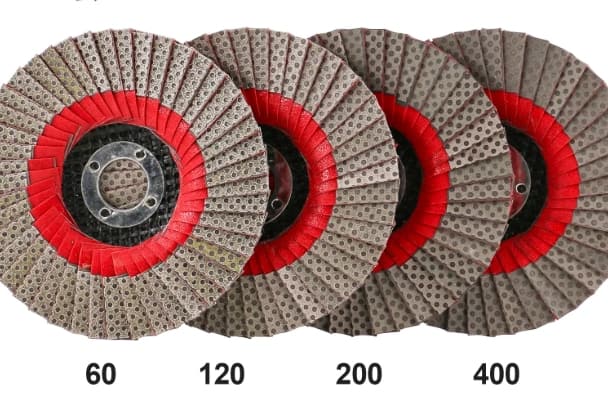
Understanding Diamond Flap Disc Grit Sizes
Selecting the right tool begins with knowing the abrasive scale. Before mounting the flap on an angle grinder, you must understand how these parameters determine your workflow. Therefore, understanding this grading system will help you avoid costly surface damage and maximize tool life.
What Does Grit Mean on a Diamond Flap Disc
What do grit numbers on diamond flap discs mean? Essentially, they represent the physical size of the diamond particles electroplated onto the tool’s flaps. The lower number means larger and coarser diamond particles. Consequently, these coarse diamonds can remove material quickly. Conversely, a higher number indicates smaller, finer diamond particles. You can use these finer diamond grits to achieve a smooth finish. Ultimately, the diamond flap disc grit explained helps you prevent unnecessary surface damage.
Common Diamond Flap Disc Grit Options
To simplify your workflow, please refer to the following diamond flap disc grit chart.
| Grit | Function | Typical Applications |
|---|---|---|
| Coarse grit (30–60) | Heavy grinding | Material removal, shaping |
| Medium grit (80–120) | Surface refining | Scratch removal, smoothing |
| Fine grit (180–400+) | Surface finishing | Polishing and surface enhancement |
Please carefully review the grit specifications for these diamond flap discs. The choice of grit size directly determines the success or failure of your project.
How Grit Selection Affects Performance
The choice of abrasive size directly affects fabrication efficiency. For example, matching the appropriate grit size to a specific task helps extend tool life. Therefore, understanding how these performance factors impact daily operations will help you achieve optimal cutting speeds.
Lower Grit for Faster Material Removal
You’ll need to use coarse diamond flap discs for heavy-duty tasks. For example, heavy-duty grinding requires grits between 30 and 60. These coarse particles provide exceptional material removal rates. As a result, you can quickly profile rough edges or remove deep scratches.
Higher Grit for Smoother Surface Finishing
Conversely, you should switch to fine grit diamond flap discs when performing precision tasks. Grits above 180 excel at surface finishing. Additionally, they prepare the material for the final polishing stage without leaving deep gouges.
Why Choosing the Wrong Grit Can Reduce Efficiency
Many professionals often make mistakes when selecting diamond flap wheels. Choosing the correct grit can prevent costly errors. If you use a fine grit for heavy grinding, the tool will overheat and wear out prematurely. Conversely, using a coarse grit for finishing will ruin your workpiece. Therefore, evaluating coarse and fine grit diamond flap discs is crucial for optimal tool life.
How to Select Grit for Diamond Flap Disc by Application
Different materials react differently to electroplated diamond abrasives. To achieve optimal results, you must tailor your abrasive selection to the specific substrate. Next, review these targeted recommendations to work with a variety of industrial materials confidently.
Choosing Grit for Stone Grinding and Polishing
When selecting diamond flap discs for stone, you must consider the rock’s hardness.
Granite
Granite requires sharp and highly aggressive tools. Therefore, the ideal diamond flap disc grit for granite starts at 60 for shaping. Next, gradually move to 120 and 200 to achieve smooth edges.
Marble
Marble is softer and more prone to chipping. Therefore, you should start with a 120 grit for marble. Then, progress to a 400 grit to achieve a refined surface.
Quartz and Engineered Stone
Engineered stone requires strict heat control. Start with 60 grit electroplated diamond flap discs to prevent resin burn. Then use 120 and 200 grit tools to remove scratches.
Selecting Grit Sizes for Concrete Grinding
Diamond flap discs used on concrete must be able to handle highly abrasive dust. Typically, a 60 grit flap disc effectively removes surface slurry. Afterward, a 120 grit option prepares the concrete for sealer application.
Choosing Grit for Stone Grinding and Polishing
Ceramic and tile are prone to cracking under high pressure. Therefore, avoid using grit sizes that are too coarse. Instead, start chamfering the edges with a 120 grit disc. Then switch to a 200 grit to achieve a clean, chip-free, factory edge.
Choosing Grit for Glass Edge Finishing
Glass processing requires extreme precision to avoid microcracks. First, use a 12 grit flap disc to quickly remove sharp edges. Finally, use a 400 grit for the finishing grind to achieve a smooth, safe surface. Our electroplated tools excel in this field and effectively prevent clogging.
Choose the Right Diamond Flap Disc from a Professional Manufacturer
Finding a reliable manufacturer of diamond flap discs ensures consistent quality. As a leading manufacturer of electroplated diamond tools, Z-LION Diamond Tools offers premium solutions. Our electroplated nickel technology ensures 100% exposure of the diamond particles. As a result, you’ll receive an abrasive that never peels and resists clogging on composite materials and glass. Whether you need a diamond abrasive supplier or customized OEM products, we can meet your needs.
The Final Words
Understanding how to select the right grit size for your diamond flap disc operations will directly impact your bottom line. By matching the grit size to your material, you can maximize both cutting speed and surface quality. Are you ready to upgrade your machining process? Get a custom quote today to receive expert advice and specific pricing for your current project.
FAQs About Diamond Flap Disc Grit Selection
What grit diamond flap disc should I use?
You should use 60 grit disc for heavy shaping and material removal. Next, use 120 grit disc for smoothing. Finally, use 200 grit or higher for fine surface finishing and preparation for polishing.
Is a higher grit diamond flap disc better?
No, a higher grit is not necessarily better. You only need to use high grits for surface finishing and polishing. Lower grits remain absolutely essential for initial material removal and heavy-duty shaping.
What is the flap disc grit sequence for grinding and polishing?
You must follow a progressive sequence. Start with 60 grit, move on to 120 grit, and finish with 200 or 400 grit. Skipping intermediate grits will leave deep scratches that are extremely difficult to remove later on.
What factors to consider besides diamond flap disc grit?
You must consider the backing material, the flexibility of the flaps, and the operating RPM. Additionally, confirm whether that specific disc performs best om dry or wet conditions.
What is the difference between 80 grit and 120 grit flap discs?
80 grit discs use larger diamond particles and are designed for moderate material removal. In contrast, 120 grit discs use smaller diamonds to refine the surface and remove scratches left by 80 grit tools.
Post time: Jul-17-2026